Foreign Criminal Cases
A foreign criminal case refers to a situation in which a foreign national becomes subject to investigation and potential punishment in Korea for violating the Criminal Act or other special criminal laws.
A major characteristic of these cases is that even after criminal proceedings end, a separate review under immigration law may continue.
When a foreign national becomes involved in a criminal case in Korea, even a minor violation or misunderstanding can escalate into serious immigration consequences such as visa problems or deportation.
1. Why Foreign Criminal Cases Do Not End as Ordinary Criminal Cases
Unlike cases involving Korean nationals, foreign criminal cases proceed through a dual structure combining criminal procedures and immigration procedures.
Prosecutorial investigation
Trial and sentencing
Criminal review (offender review) by immigration office
Decision on visa status and residency
Even a single police investigation or a simple fine may be reported to immigration authorities, potentially leading to
Key factors reviewed include:
2. Major Types and Issues in Foreign Criminal Cases
Common types of foreign criminal cases include the following.
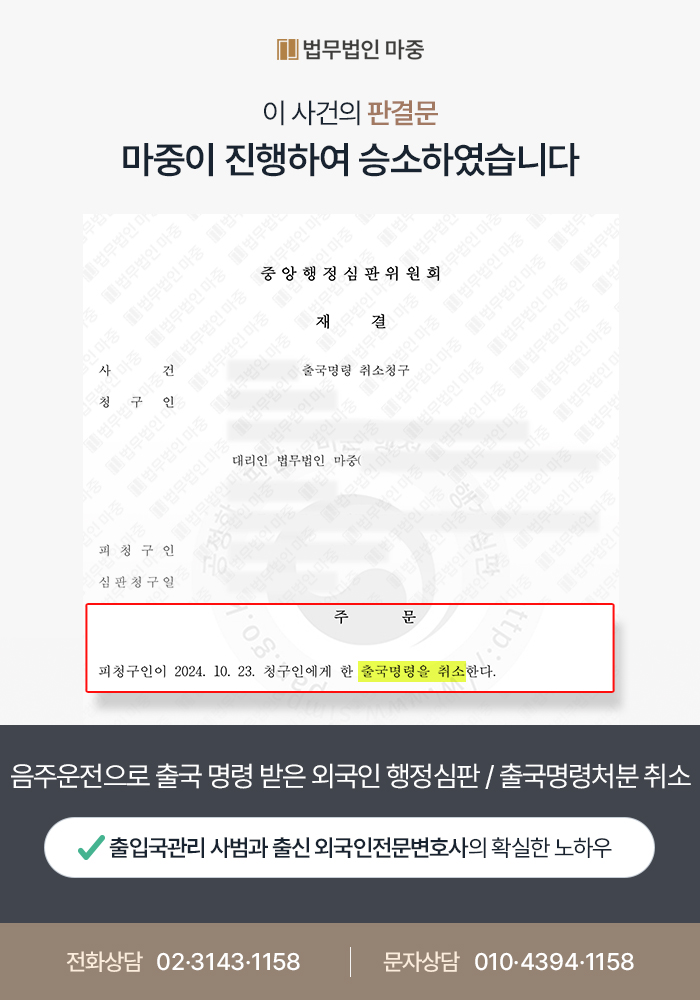
☑ Foreign Criminal Cases: Drunk Driving
Drunk driving by foreign nationals is punished under the Road Traffic Act in the same way as for Korean citizens. However, even a fine may directly affect immigration status.
The criminal penalty varies depending on:
- blood alcohol concentration
- repeat offenses
- whether an accident occurred
After the criminal case concludes, immigration authorities may review the case and determine whether to refuse visa extension or order deportation.
Particularly in the following cases, deportation risk increases:
Early legal response is therefore very important.
☑ Foreign Criminal Cases: Sexual Offenses
Sex crimes committed by foreign nationals are often considered serious threats to social order from an immigration perspective.
Crimes such as:
- sexual assault
- indecent assault
- quasi-indecent assault
may lead to difficulty maintaining legal residency even for first-time offenders.
Key factors include:
These elements influence both criminal sentencing and immigration review outcomes.
☑ Foreign Criminal Cases: Drug Offenses
Drug-related crimes involving foreign nationals are treated very strictly.
Even simple drug use may result in serious consequences.
If convicted under the Narcotics Control Act:
If possession is also proven, authorities may view the offense as more serious due to:
- continuity of the conduct
- potential for further distribution
As a result, even first-time offenders may face difficulty maintaining residency.
☑ Foreign Criminal Cases: Assault and Injury
When a foreign national becomes involved in an assault case, the outcome may vary depending on:
- whether the case constitutes simple assault or bodily injury
- whether a settlement was reached with the victim
Examples:
Immigration authorities review:
- circumstances of the offense
- likelihood of reoffending
- stability of life in Korea
☑ Foreign Criminal Cases: Illegal Foreign Exchange Transactions (Hwan-Chigi / Illegal Remittance)
Illegal remittance (commonly called hwan-chigi) constitutes a violation of the Foreign Exchange Transactions Act.
For foreign nationals, this may be treated as a serious offense depending on the scale and repetition of the transactions.
Authorities consider:
- ▶ source of funds
- ▶ involvement in organized networks
- ▶ relation to the foreign national’s stated purpose of stay
Because of these factors, such cases often carry high deportation risk after criminal proceedings.
☑Foreign Criminal Cases: Use of False Identity or Forged Documents
Using:
- another person’s passport
- a false passport
- forged visa documents
- falsified identity documents
may constitute serious crimes under the Criminal Act and Immigration Control Act.
In many cases, regardless of criminal punishment, the consequences may include
Therefore, immigration-focused defense from the earliest stage is essential.
3. Important Points for Early Response
In foreign criminal cases, problems often arise after the criminal process rather than during it.
If the following points are overlooked, even relatively light criminal penalties may lead to immigration consequences:
Statements made during investigations become part of the official criminal record and may also be used during immigration review.
Therefore, statements and explanations during early investigations must be carefully managed.
4. Important Considerations After Criminal Sentencing
Many foreign nationals assume that a case ends once criminal punishment is finalized.
However, for foreign criminal cases, immigration procedures often begin in earnest after sentencing.
Residency status may become difficult to maintain in the following situations:
Immigration authorities evaluate not only the sentence but also the nature of the offense and the individual's degree of settlement in Korea.
5. Key Summary Points
In foreign criminal cases, immigration status often becomes a greater issue than the criminal penalty itself.
The appropriate response strategy and supporting materials may vary greatly depending on:
- the stage of the case
- the type of offense involved