International Divorce
International divorce refers to a divorce process in which one or both spouses hold foreign nationality, or where the marriage, residence, or property relationship is connected to two or more countries.
Unlike a domestic divorce, an international divorce requires review not only of Korean family law, but also of private international law, immigration law, and the possible application of foreign law.
1. International Divorce: Standards for Determining the Governing Law
Before proceeding with an international divorce, it is first necessary to determine which country’s law applies, that is, the governing law. This is one of the most fundamental and important steps in an international divorce case.
In general, the review proceeds in the following order:
- If both spouses share the same nationality, the law of that country
- If both spouses share the same habitual residence, the law of that country
- If both nationality and residence differ, the law of the country most closely connected to the marriage
Even where the spouses have different nationalities, if the center of their married life was in Korea, Korean law may be determined to be the governing law. In that case, the international divorce procedure may proceed through a Korean family court.
2. International Divorce: Procedure Where Agreement Is Possible
Even in an international divorce, if both spouses agree to divorce, the matter may in some cases proceed as a consensual divorce.
However, if one spouse is a foreign national, more preparation is generally required than in an ordinary consensual divorce.
To proceed with a consensual divorce, the following are generally required:
- A clear agreement on the intention to divorce
- If there are children, agreement on custody and parental authority
- Compliance with court guidance and the statutory reflection period
- Divorce registration after court confirmation
If the foreign spouse resides overseas, personal appearance may be difficult, and additional documents such as notarized papers, translations, and an apostille may be required. Because required documents vary by country, advance verification is necessary.
3. International Divorce: How to Proceed in Cases of Dispute or Lost Contact
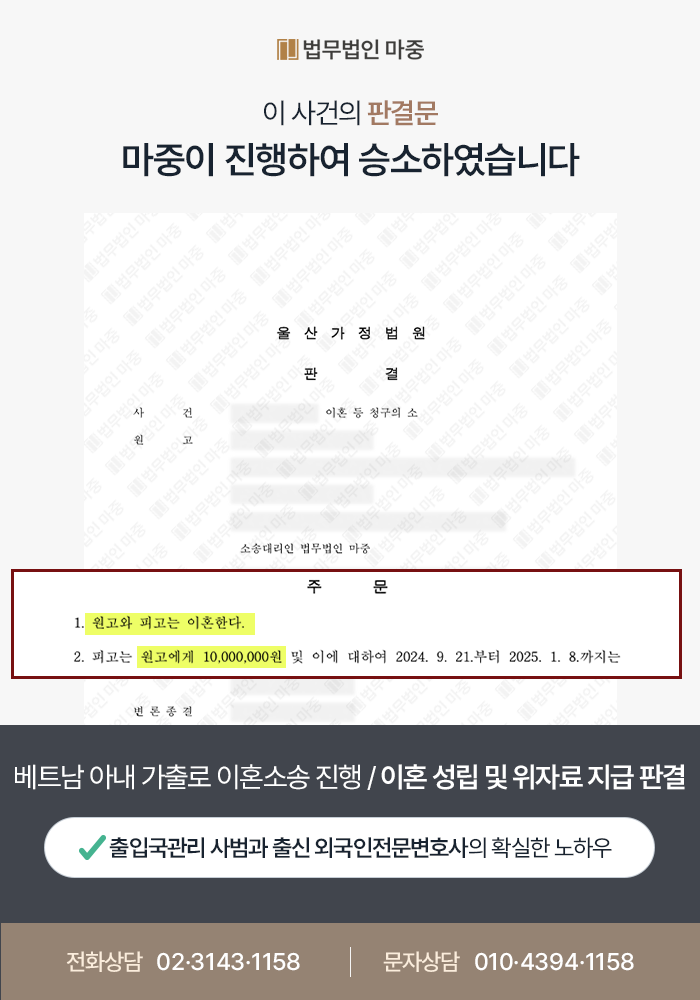
If the other spouse does not agree to the divorce, or if the foreign spouse has left home or cannot be contacted, the case generally proceeds as a judicial divorce. In such cases, an important issue is whether a Korean family court has jurisdiction and how the complaint can be served.
If the other party’s address or residence cannot be confirmed, the court may, in exceptional circumstances, permit service by publication.
Service by publication is a procedure under which, when direct service of the complaint is impossible, service is deemed completed through court posting. This is frequently used in international divorce cases.
If service by publication is permitted, the trial may proceed regardless of whether the other party appears, and if the legal requirements are met, a divorce judgment may be granted.
4. International Divorce: Child Custody and Parental Rights
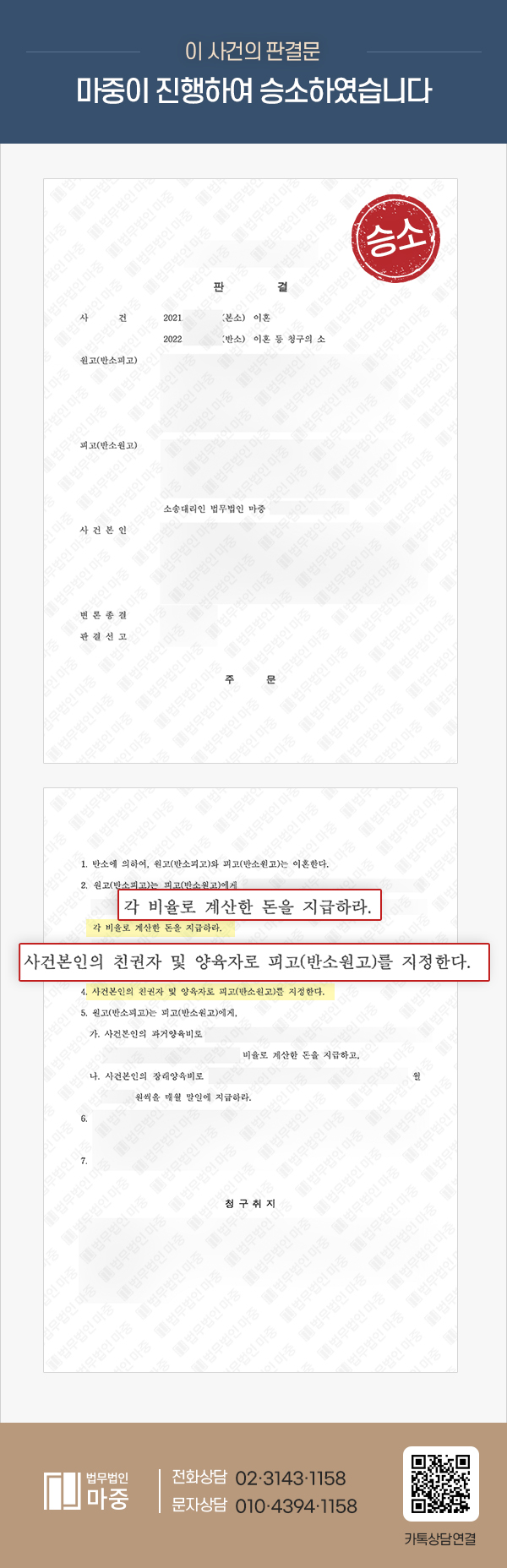
If there are minor children in an international divorce, issues of custody and parental authority are reviewed with the utmost care. The family court does not primarily base its decision on the parents’ nationality or immigration status, but on the best interests of the child.
Main factors considered include:
- The child’s current primary living environment
- Continuity and stability of caregiving
- Access to language, education, and medical care
- Each parent’s caregiving ability and stability of residence
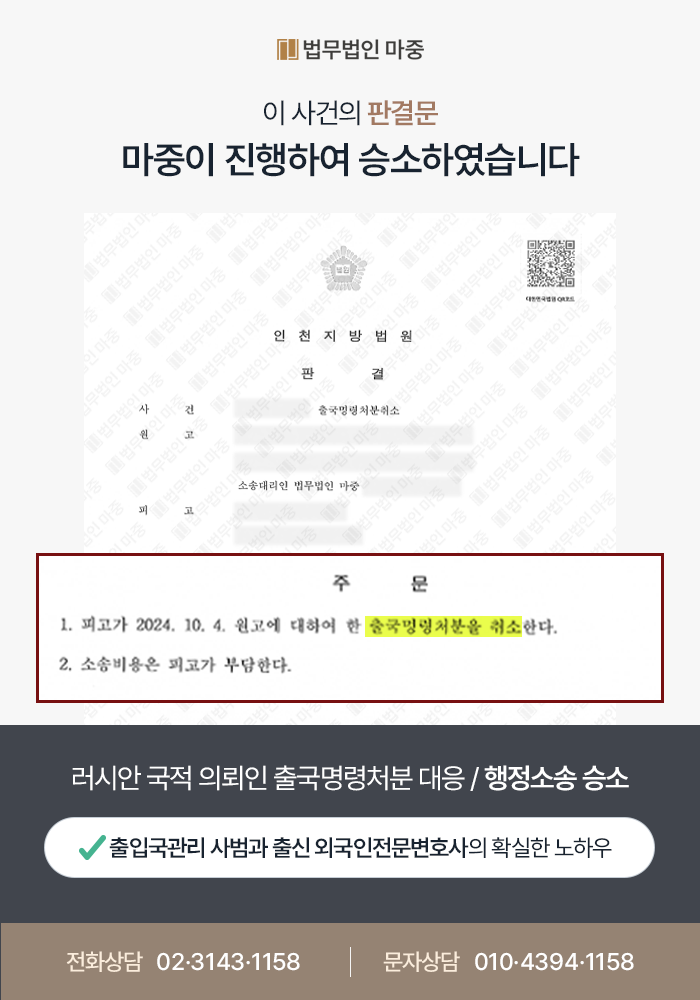
In particular, if there is a risk that the foreign spouse may leave the country with the child, protective measures such as an exit ban request or temporary custody designation may be necessary. For that reason, early response is important.
5. International Divorce: Property Division and Claims for Damages
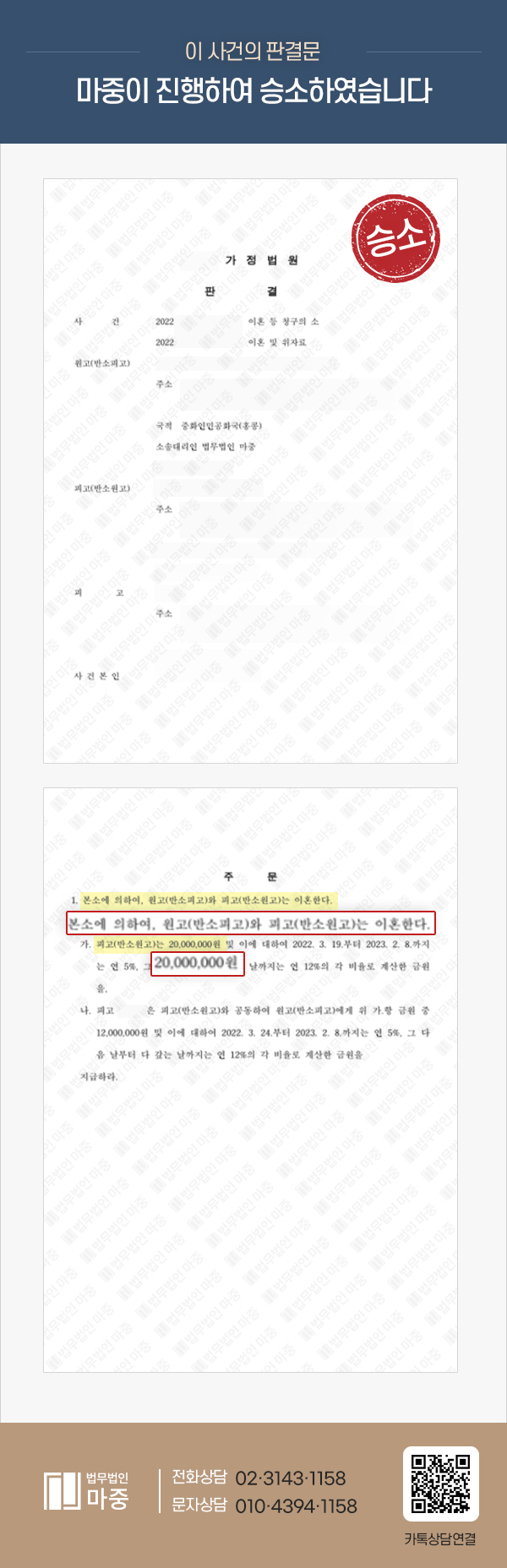
In international divorce as well, property division is generally determined based on each spouse’s contribution to the property formed during the marriage. A spouse is not excluded from division merely because of a different nationality.
However, in practice, the following circumstances often make the matter more difficult:
- Existence of real estate, bank accounts, or businesses located overseas
- Difficulty obtaining overseas financial records
- Need for translation and notarization of foreign documents
In such cases, the evidentiary structure should be designed around remittance records, income materials, and proof of joint marital life, while also reviewing the foreign legal environment where necessary.
6. International Divorce: Reviewing Nullity or Annulment of Marriage
Not all disputes arising from an international marriage are resolved through divorce.
If there are circumstances showing that there was no true intent to form a marital life together from the beginning of the marriage, nullity or annulment of marriage may be recognized.
For example:
- One spouse left home immediately after acquiring immigration status following marriage registration
- There is no meaningful trace of cohabitation or shared life at all
- Contact was cut off after repeated financial demands
However, such circumstances do not automatically establish nullity of marriage. A comprehensive legal assessment of the overall circumstances before and after the marriage is required.
7. International Divorce: Why Early Response Is Important
International divorce is not merely a procedure for ending a marital relationship. It is a complex legal matter that may also involve nationality, jurisdiction, governing law, children, property, and immigration status.
Even where a foreign spouse has left home or has been unreachable for a long period, a judicial divorce through service by publication may still be possible in some cases. In other cases, seeking nullity of marriage may be more appropriate.
However, if the wrong procedure is selected, the burden of time and cost may increase significantly. For that reason, it is important to accurately understand the overall structure of the case from the outset.